

ABET – XÂY DỰNG BẢNG MAPPING CHO THU THẬP DATA CHU KỲ 1
30/09/2019
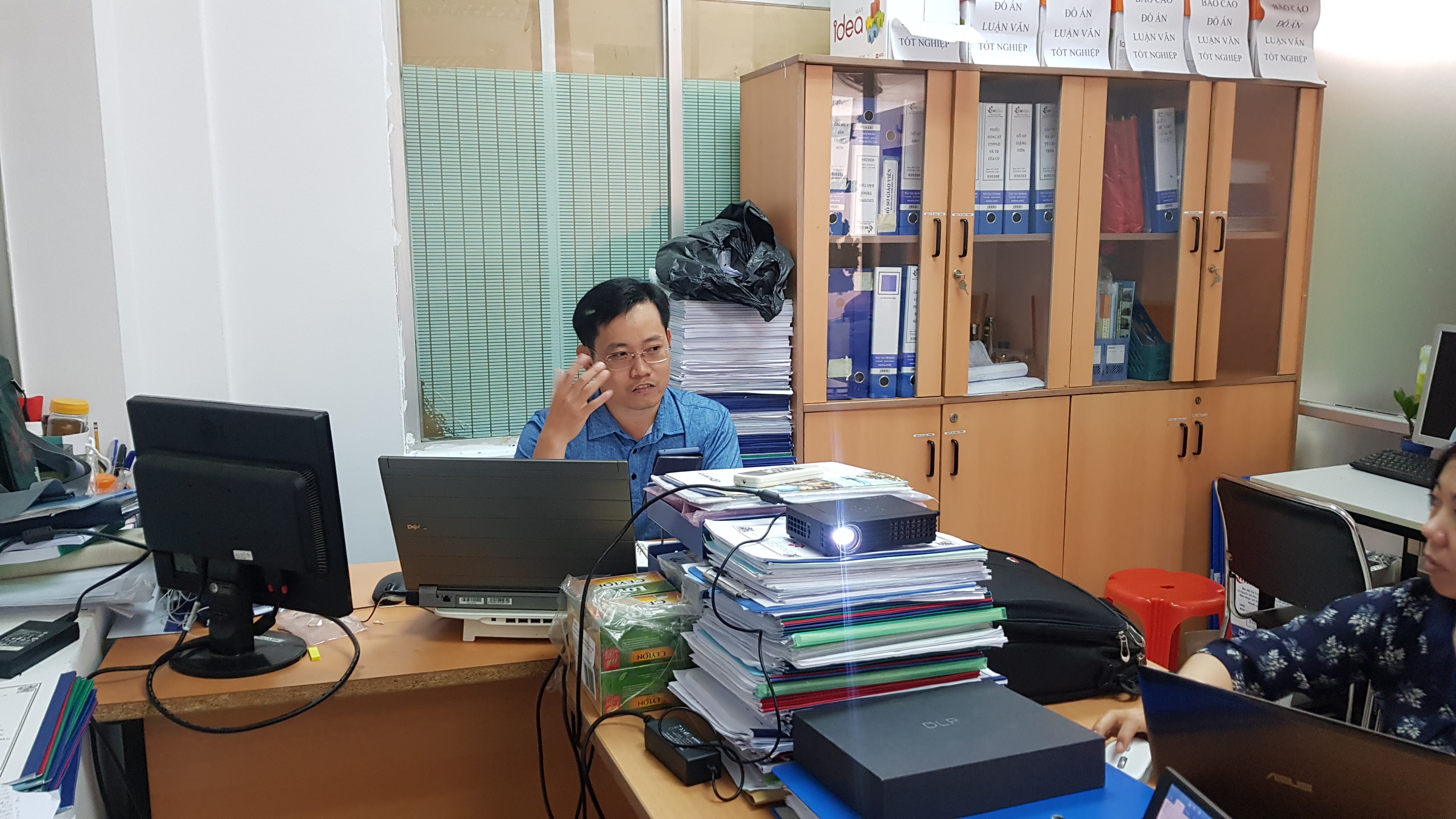
Cuộc thảo luận diễn ra vào ngày 24 tháng 09 năm 2019
Địa điểm: Văn phòng BM CNTP, trường ĐH Công Nghiệp TP.HCM, 12 Nguyễn Văn Bảo, Gò Vấp, TP. Hồ Chí Minh
Thành phần: Thầy Nguyễn Đức Vượng
Thầy Nguyễn Bá Thanh
Thành viên: Các thầy cô trong ban ABET CNTP
Nội dung chính
Họp nhóm ABET CNTP về xay dựng bảng Mapping các môn học phục vụ lẫy dữ liệu cho chu kỳ 1
Ý kiến thảo luận
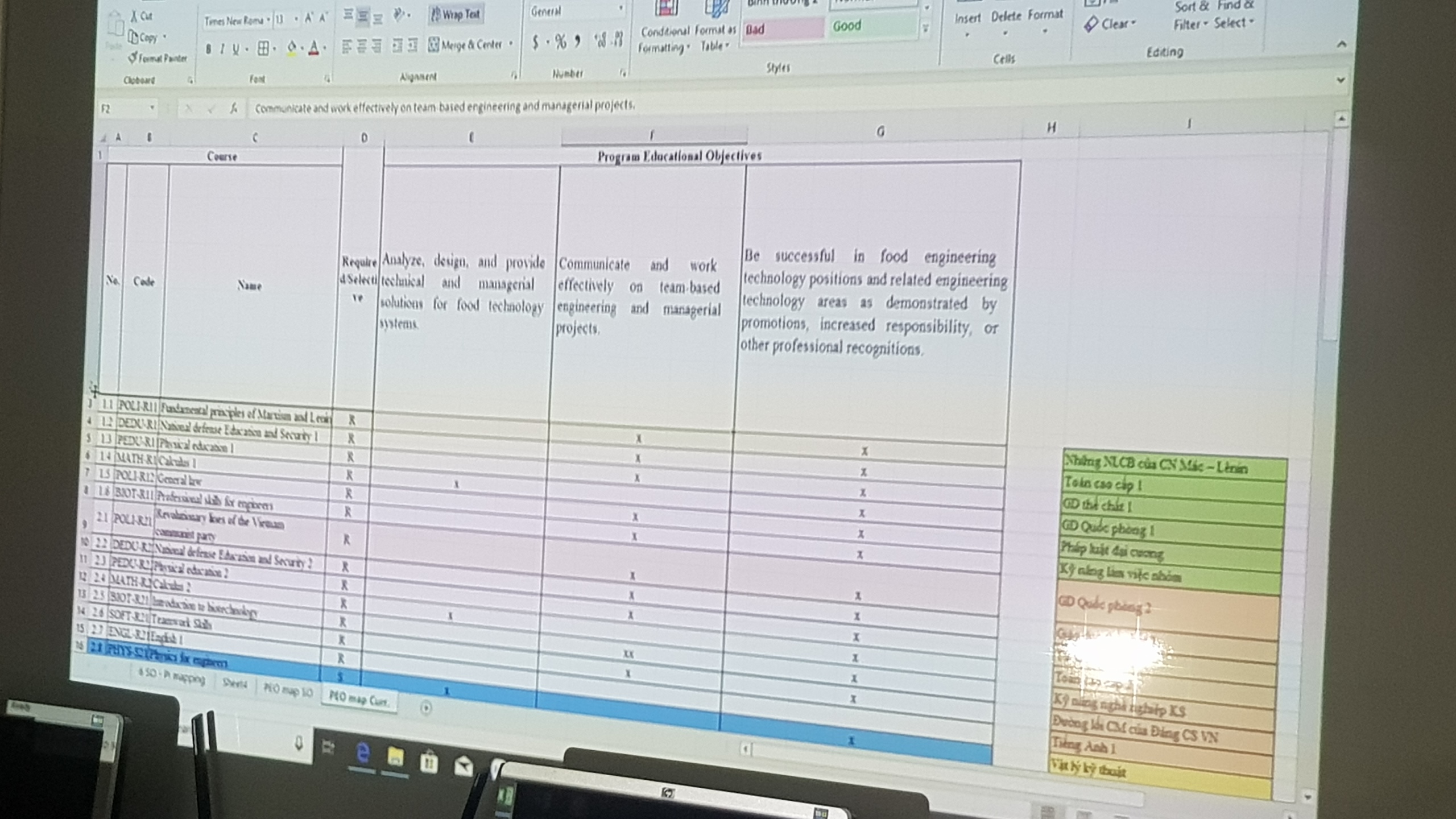
- Xây dựng bảng mapping giữa SO và PI
Student outcomes Performance Indicators 1. An ability to apply knowledge, techniques, skills, and modern tools of mathematics, science, engineering, or technology to solve broadly-defined in food engineering technology problems. 1.1 Calculate technical engineering parameters (machines, equipment, processes) to solve problems in FET. 1.2 Apply chemical, physical and biological principles to explain phenomena in FET. 1.3 Operate machine and equipment used in food productions. 1.4 Apply modern tools of mathematics, science, engineering, or technology to solve problems related to FET. 2. An ability to design systems, components, or processes meeting specified needs for broadly-defined engineering problems. 2.1 Design system components related to FET. 2.2 Design food engineering technology systems. 2.3 Design food product and its food processing processes using diagrams / flowcharts or other tools. 3. An ability to conduct standard tests, measurements, and experiments and to analyze and interpret the results to improve processes. 3.1 Conduct standard tests and measurements in food engineering technology. 3.2 Plan and conduct experiments in food engineering technology. 3.3 Analyze and interpret experimental results to improve processes. 4. An ability to function effectively as a member or leader on a technical team. 4.1 Participate in team discussion and contribute ideas to solve a particular task. 4.2 Complete assigned tasks as leader or team member in timely manner. 4.3 Collaborate with other team members to accomplish team’s tasks 5. An ability to apply written, oral, and graphical communication in both technical and nontechnical environments; and an ability to identify and use appropriate technical literatures. 5.1 Apply written communication in technical environments. 5.2 Apply oral communication in technical environments. 5.3 Apply graphical communication on technical environments. 5.4 Identify and use appropriate technical literatures.
- Xây dựng bảng mapping giữa PI/SO với CLO
| SO 1, PI 1 | 1.1 Calculate technical engineering parameters (machines, equipment, processes) to solve problem in FET | ||
| Semester | Course | CLO | Type |
| 3 | Food Engineering 1 | CLO2: Calculate the specific parameters of fluid transfer equipments | I |
| 3 | Food Engineering 1 | CLO3: Calculate the specific parameters of mechanical separation process | I |
| 3 | Food Engineering 1 | CLO4: Calculate the basic parameters of heat trasfer process | I |
| 3 | Food Engineering 1 | CLO5: Calculate the basic parameters of concentration process | I |
| 4 | Food Engineering 2 | CLO2: Calculate material balance, energy balance in particular stages or processes | R |
| 4 | Fundamental processes in Food Engineering Technology | CLO5: Calculate mass balance through stages and processes | R |
| 6 | Food Machine Design | CLO3: Calculate the basic elements of food processing equipments | E |
| 7 | Food Plant Design | CLO2: Calculate mass balance, energy balance in particular processes to determine materials and energy required in để xác định lượng nguyên liệu, năng lượng cần thiết cho QTSX | E |
| SO 1, PI 2 | 1.2 Apply chemical, physical and biological principles to explain phenomena in food engineering technology. | ||
| Semester | Course | CLO | |
| 3 | Microbiology | CLO2: Present scientific principles of physical, chemical methods in controlling microbial growth | I |
| 3 | Biochemistry | CLO4: Present biochemical characteristics which applied on food production | I |
| 4 | Food Microbiology | CLO1: Explain food deterioation phenomena caused by micoorganism | R |
| 4 | Fundamental processes in Food Engineering Technology | CLO1: Explain changes in food processing and preservation technology. | R |
| 4 | Fundamental processes in Food Engineering Technology | CLO4: Explain the basic problems in food processing and preservation technology. | R |
| 5 | CNCB TP | CLO1: Select adequate food materials to particular food production process | R |
| 6 | Agricultural Products Processing Technology | CLO3: Explain the root causes of some technical problems in agricultural product processing | E |
| 6 | Animal Husbandary and Aquatic Product Processing Technology | CLO3: Explain the root causes of some technical problems in animal husbandary and aquatic product processing | E |
| 6 | Beverage Processing Technology | CLO6: Explain the root causes of some technical problems in beverage product processing | E |
| 6 | Milk and Dairy Product Processing technology | CLO4: Explain the root causes of some technical problems in milk and dairy product processing | E |
| 6 | Confectionery Processing Technology | CLO2: Explain the root causes of some technical problems in confectionery product processing | E |
| 6 | Tropical Product Processing Technology | CLO3: Explain the root causes of some technical problems in tropical product processing | E |
| SO 1, PI 3 | 1.3 Operate machine and equipment used in food productions | ||
| Semester | Course | CLO | |
| 3 | Food Engineering 1 | CLO1: Describe the structures and operational principles of fluid transfer equipment, mechanical separation processes, heat transfer processes and concentration processes. | I |
| 4 | Fundamental processes in Food Engineering Technology | CLO2: Present the methods and select the equipments to carry out the food processing and preservation technology. | R |
| 4 | Food Engineering 2 | CLO3: Operate equipments, perform measurements, analyze relevent parameters of hydrautic processes, heat trasfer and mass transfer | R |
| 6 | Agricultural Products Processing Technology | CLO4: Operate main machines and equipment used in agricultural product processing at the laboratory | E |
| 6 | Animal Husbandary and Aquatic Product Processing Technology | CLO4: Operate main machines and equipment used in animal husbandary and aquatic product processing at the laboratory | E |
| 6 | Beverage Processing Technology | CLO7: Operate main machines and equipment used in beverage product processing at the laboratory | E |
| 6 | Milk and Dairy Product Processing technology | CLO5: Operate main machines and equipment used in milk and dairy product processing at the laboratory | E |
| 6 | Confectionery Processing Technology | CLO3: Operate main machines and equipment used in confectionery product processing at the laboratory | E |
| 6 | Tropical Product Processing Technology | CLO4: Operate main machines and equipment used in tropical product processing at the laboratory | E |
| SO 1, PI 4 | 1.4 Apply modern tools of mathematics, science, engineering, or technology to solve problems in FET | ||
| Semester | Course | CLO | |
| 2 | Toán CC 2 | CLO3: Calculate linear mapping matrix | I |
| 3 | Data Analysis | CLO4: Carry out descriptive and inference statistics | R |
| 6 | Sensory Evaluation of Foods | CLO4: Apply statistical software to analyze data and explain the result of sensory experiment | E |
| KLTN | CLOX Sử dụng công cụ để phân tích dữ liệu thí nghiệm và đưa ra kết luận giải quyết vấn đề | E | |
| Dinh dưỡng và ATTP | E | ||
| SO 2, PI 1 | 2.1 Design system components related to food engineering technology. | ||
| Semester | Course | CLO | |
| 4 | Fundamental processes in Food Engineering Technology | CLO3: Building parameters of food processing processes based on known knowledge | I |
| 6 | Food Machine Design | CLO2: Identify suitable materials making equipments and machineries | R |
| 7 | Food Plant Design | CLO3: Design a food plant layout focus on machinery placement | E |
| SO 2, PI 2 | 2.2 Design food engineering technology systems. | ||
| Semester | Course | CLO | |
| 5 | Nutrition and Food Safety | CLO4: Propose measures to prevent food poisoning cases in food production through PBL group reports | I |
| 5 | Food Processing Technology | CLO3: Present one of the basic technological processes in the production and processing of typical food products | I |
| 6 | Agricultural Products Processing Technology | CLO5: Explain about a particular agricultural product processing procedure | R |
| 6 | Animal Husbandary and Aquatic Product Processing Technology | CLO5: Explain about a particular animal husbandary and aquatic product processing procedure | R |
| 6 | Beverage Processing Technology | CLO8: Explain about a particular beverage product processing procedure | R |
| 6 | Milk and Dairy Product Processing technology | CLO6: Explain about a particular milk and dairy product processing procedure | R |
| 6 | Confectionery Processing Technology | CLO4: Explain about a particular confectionery product processing procedure | R |
| 6 | Tropical Product Processing Technology | CLO5: Explain about a particular tropical product processing procedure | R |
| 7 | Food Quality Assurance and Food Law | CLO4: Establish a HACCP plan for some food products. | E |
| 7 | Food Plant Design | CLO4: Design a working place for food plant | E |
| SO 2, PI 3 | 2.3 Design food product and its food processing processes using diagrams/flowcharts or other tools. | ||
| Semester | Course | CLO | |
| 4 | Food Chemistry | CLO1: List the roles and characteristics of vitamin, mineral, color, aroma in food processing technology | I |
| 6 | Agricultural Products Processing Technology | CLO6: Practically produce some particular agricultural products at the laboratory | R |
| 6 | Animal Husbandary and Aquatic Product Processing Technology | CLO6: Practically produce some particular animal husbandary and aquatic produts at the laboratory | R |
| 6 | Beverage Processing Technology | CLO9: Practically produce some particular beverage products at the laboratory | R |
| 6 | Milk and Dairy Product Processing technology | CLO7: Practically produce some particular milk and dairy products at the laboratory | R |
| 6 | Confectionery Processing Technology | CLO5: Practically produce some particular confectionery products at the laboratory | R |
| 6 | Tropical Product Processing Technology | CLO6: Practically produce some particular tropical products at the laboratory | R |
| 6 | Food Packaging | CLO4: Design packaging for a food product to meet regulations | R |
| 8 | Food Product Design and Development Practice | CLO4: Design food product in the time manner (T. Phương) | E |
| SO 3, PI 1 | 3.1 Conduct standard tests and measurements in food engineering technology. | ||
| Semester | Course | CLO | |
| 3 | Chemical Analysis | CLO1: Present the chemical preparation, storage method and calculate chemical quantity required | I |
| 3 | Chemical Analysis | CLO2: Present principle and condition of analytical methods in Trình bày được nguyên tắc và điều kiện xác định của các phương pháp phân tích trong các lĩnh vực hóa học, thực phẩm, môi trường | I |
| 3 | Biochemistry | CLO1: Conduct biochemical testings and experiments | R |
| 4 | Food Analysis | CLO6: Conduct standard food analysis tests | E |
| SO 3, PI 2 | 3.2 Plan and conduct experiments in food engineering technology. | ||
| Semester | Course | CLO | |
| 3 | Data Analysis | CLO6: Design one/two factorial experiments | I |
| 5 | Food Additive | CLO4: Conduct tests to check some properties of typical food additives in laboratory | R |
| 6 | PPL NCKH | CLO2: Apply known knowledge and skill to design experiments in research proposal | R |
| 8 | Food Product Design and Development Practice | CLO3: Plan and conduct experiments to establish technical parameters for food processing steps | E |
| SO 3, PI 3 | 3.3 Analyze and interpret experimental results to improve processes | ||
| Semester | Course | CLO | |
| 3 | Data Analysis | CLOX: Thực hiện được các tính toán và mối quan hệ giữa các đại lượng thống kê | I |
| 5 | Food Additives | CLO3: Analyze experimental results to choose suitable food additive for a particular food product | R |
| 6 | Sensory Evaluation of Foods | CLO4: Collect , analyze data, and explain the results of sensory experiment | R |
| KLTN | CLO2. Analyze the experimental data to give clear conclusions and recommendations | ||
| 8 | Food Product Design and Development Practice | CLOX: Analyze and interpret experimental results to choose suitable technical parameters for food product development | E |
| SO 4, PI 1 | 4.1 Participate in team discussion and contribute ideas to solve a particular task. | ||
| Semester | Course | CLO | |
| 1 | Soft Skill | CLO1: Present and explain about general team work skills | I |
| 2 | Professional Skills For Engineers | CLO4: Participate in team discussion and contribute ideas | R |
| 7 | Food Product Design and Development | CLO5: Discuss and make agreement within a team | E |
| SO 4, PI 2 | 4.2 Complete assigned tasks as leader or team member in timely manner. | ||
| Semester | Course | CLO | |
| 1 | Soft Skill | CLO2: Conduct team work | I |
| 1 | Soft Skill | CLO3: Apply necessary skills to have effective working team | I |
| 2 | Professional Skills For Engineers | CLOX: Complete an assigned task in timely manner | R |
| 2 | Professional Skills For Engineers | CLOX: Build up leam leader skill for ech team member | R |
| 7 | Food Product Design and Development | CLO6: Assign task for each team member and complete that assigned task in timely manner | E |
| SO 4, PI 3 | 4.3 Collaborate with other team members to accomplish team’s tasks. | ||
| Semester | Course | CLO | |
| 1 | Soft Skill | CLO4: Build up an active, unite behavior in team work | I |
| 2 | Professional Skills For Engineers | CLO3: Collaborate with other members within a team | R |
| 7 | Food Product Design and Development | CLO7: Collaborate with other members within a team to accomplish an assigned task | E |
| SO 5, PI 1 | 5.1 Apply written communication in both technical and non-technical environments. | ||
| Semester | Course | CLO | |
| 2 | Professional Skills For Engineers | CLO1: Write a team essay report | I |
| 3 | Biochemistry | CLO5: Present experimetal results effectively | R |
| Thực tập nhà máy | Perform effectively written communication in non-technical environment (phần đánh máy) | E | |
| KLTN | Perform effectively written communication in technical environment | E | |
| SO 5, PI 2 | 5.2 Apply oral communication in both technical and non-technical environments. | ||
| Semester | Course | CLO | |
| 2 | Professional Skills For Engineers | CLO6 Thuyết trình được bài tiểu luận trước lớp | I |
| 5 | Nutrition and Food Safety | CLO3: Present measures related to nutrition and food safety through PBL group reports | R |
| 7 | Thực tập nhà máy | Ability to communicate to company’s staffs | E |
| 7 | Food Product Design and Development Practice | Present a particular food product development process (T. Phương) | E |
| SO 5, PI 3 | 5.3 Apply graphical communication on both technical and non-technical environments. | ||
| Semester | Course | CLO | |
| 3 | Data Analysis | CLO3: Sellect appropriate plots for data presentation | I |
| 6 | Sensory Evaluation of Foods | CLO5: Present data and results vie various types of graphs | R |
| 8 | Food Product Design and Development (Practice) | CLOX: Demonstrate experiment data through adequate and efficient graphical performance | E |
| 8 | KLTN | Demonstrate experiment data through adequate and efficient graphical performance | |
| SO 5, PI 4 | 5.4 Identify and use appropriate technical literatures. | ||
| Semester | Course | CLO | |
| 2 | Professional Skills For Engineers | CLOX: Find references | I |
| 4 | Food Chemistry | CLOX: Sellect appropriate technical literatures | R |
| 5 | Nutrition and Food Safety | CLOX: Use appropriate technical literatures | R |
| 8 | KLTN | Use references effectively | E |
Kiến nghị: Tiếp tục làm việc ở các buổi họp sau về data các môn E cho chu kỳ 2
Một vài hình ảnh liên quan đến hoạt động

TIN NỔI BẬT
Đơn vị liên kết


